
If you searched for "is Seedance 2 free," the practical answer is yes, but only in a limited sense. You can test Seedance 2 without paying upfront, yet there is no single universal unlimited free tier that covers every official route, every region, and every serious production workflow. What actually exists is a mix of daily free credits, app-level paid unlocks, enterprise-style access, and third-party platforms that package the model inside their own credit system.
That difference matters because most people are not really asking whether Seedance 2 costs exactly zero forever. They are asking three more useful questions: Can I test it before I pay? How do credits work once I want real output volume? And which access path is least annoying for the way I actually create videos? This guide answers those questions directly and avoids pretending there is one neat public price sheet that covers every Seedance 2 entry point.
The Short Answer
As of April 5, 2026, the best way to think about Seedance 2 pricing is this: free access is mainly for testing, not for sustained output. Official consumer surfaces such as Dreamina advertise free daily credits, while more serious access paths shift toward app checkout, enterprise onboarding, or API-style usage. If you want the lowest-friction way to compare cost against usable credits, public platform pricing is usually easier to budget than app-specific or enterprise-specific billing.
| Access path | Can you try it free? | Best for | Main tradeoff |
|---|---|---|---|
| Dreamina / Jimeng | Yes, limited daily free credits | Casual testing and prompt exploration | Paid pricing is usually surfaced inside the app or checkout flow rather than one stable public global matrix |
| Volcengine / Ark route | Not the easiest free consumer path | Enterprise, platform, or API-minded teams | Higher setup complexity and less consumer-friendly onboarding |
| Seavidgen | Yes, 5 starter credits | Predictable credits and multi-model workflows | Uses platform credits rather than official Dreamina-native billing |
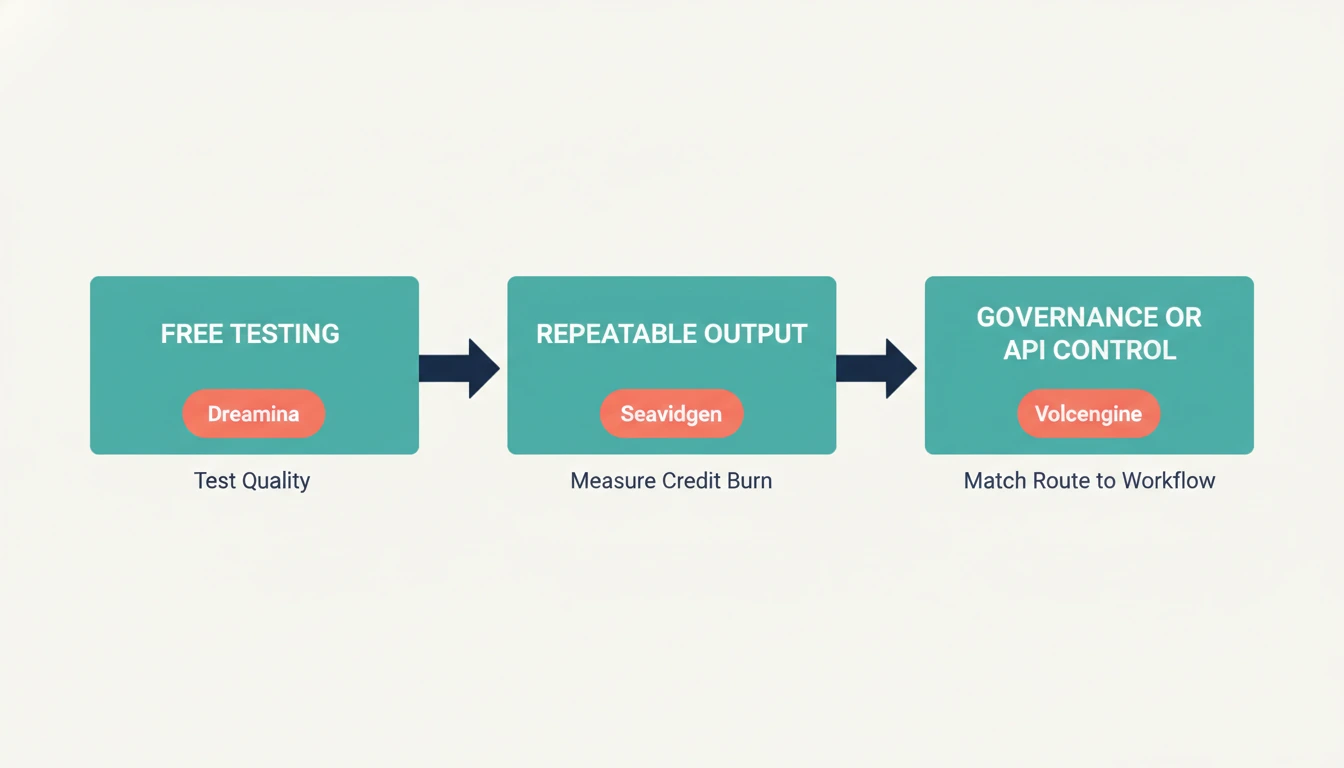
The simplest rule is to use free credits to validate quality, then switch to the access path that matches your real workload. If you only want to see whether Seedance 2 can handle your prompt style, the free route is enough. If you need repeatable delivery, you should compare published credit allowances, concurrency limits, watermark rules, and workflow friction instead of staring only at the headline monthly price.
What "Free" Really Means for Seedance 2
Most confusion comes from the word free doing too much work. In practice, free access usually means one or more of these conditions:
- you get a small daily credit allowance
- output limits are lower than paid usage
- quality, queue priority, or advanced controls can be restricted
- the free tier is good for testing, not for production volume
- availability can vary by region, campaign, or current rollout state
That is why two people can both be "right" online while describing different experiences. One person may be using a current Dreamina free allowance. Another may be looking at an in-app paywall, a region-specific plan, or an enterprise route that was never designed as a casual free product in the first place. The right question is not "is there any free button anywhere?" The right question is "which kind of free access exists for my workflow, and what stops being free the moment I need reliable throughput?"
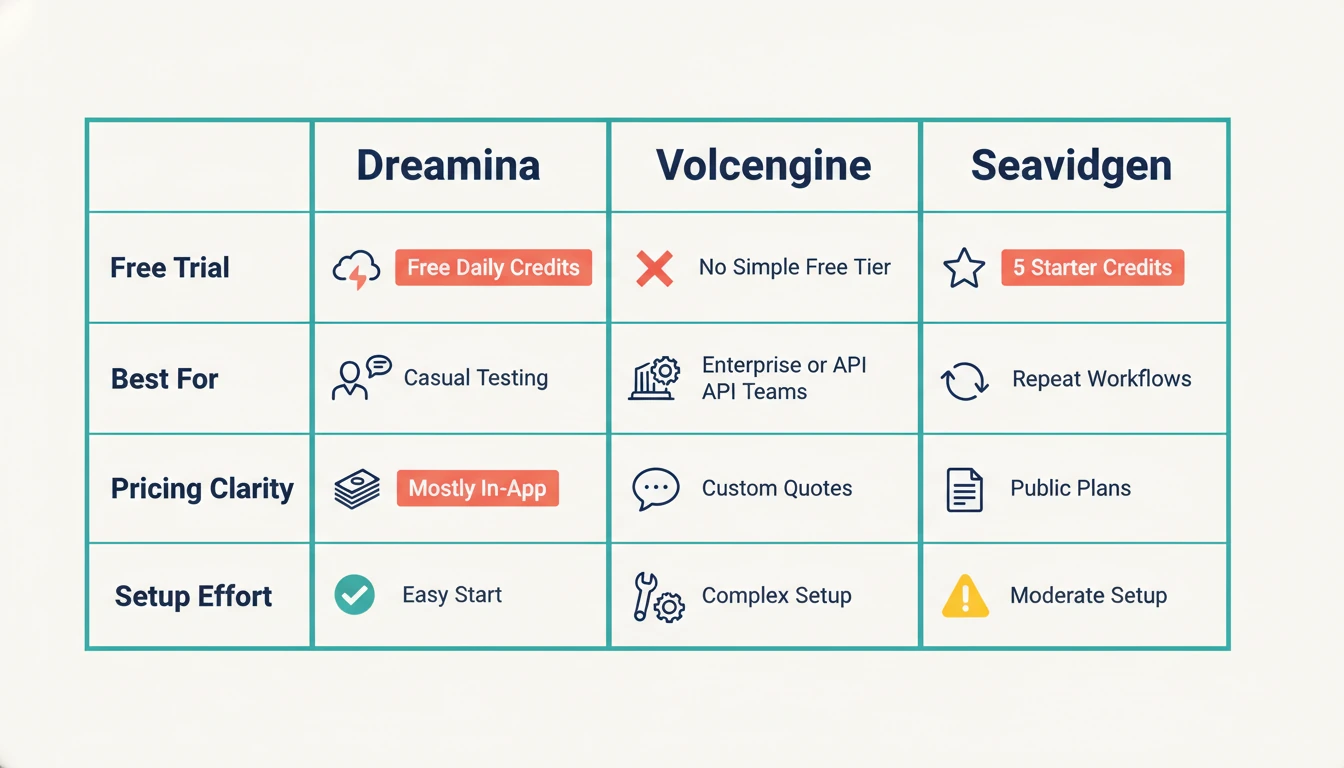
For Seedance 2, the usual breakpoint appears when you move from experimentation to repeat production. That is the moment when daily free credits stop being enough, queue time starts to matter, and budgeting becomes part of the decision. If your work involves client delivery, team review, or multi-model routing, the lowest-friction platform often beats the most "official" path on pure usability.
The Real Access Options Right Now
1. Dreamina is the easiest official-style path for casual testing
Dreamina is the most straightforward answer for people who want to try Seedance-class generation before committing money. The public messaging on Dreamina pages emphasizes free daily credits, which makes it the most understandable starting point for solo creators who just want to test motion quality, prompt obedience, and general creative fit.
Dreamina is strongest when you want to:
- test whether Seedance 2 matches your visual taste
- compare a few prompts without long setup
- validate short-form use cases before choosing a paid route
- avoid enterprise-style onboarding
Its biggest weakness is pricing clarity. The free entry is clear enough. The paid layer is less universal. Depending on the exact product surface, region, or campaign, the real checkout details may appear inside the app or flow rather than on a stable public webpage. That does not mean Dreamina is unusable. It simply means you should treat it as a testing-first path, then verify current checkout terms inside your own account before making budget decisions.
2. Volcengine is the better fit when you care about platform or API control
Volcengine is the route to watch if you are less interested in casual creation and more interested in structured access, product integration, or enterprise-style control. This is usually the better mental model for teams building workflows, not just creators making a few clips.
Volcengine makes more sense when you need:
- platform-level procurement or account management
- API-oriented planning
- a path that better matches team or product infrastructure
- more formal operational control than a consumer app usually provides
The tradeoff is obvious. This route is less friendly for someone who only wants a fast answer to "can I make three sample videos today?" If you are not an enterprise buyer or developer-minded team, the setup overhead can outweigh the benefits.
3. Seavidgen is the easier path when you want public plan math and repeatable credits
Seavidgen is useful because it turns a fuzzy access question into a more budgetable one. Instead of guessing how many usable generations you can squeeze from an app-level free allowance, you can compare published credits, plan sizes, and concurrency directly. That matters for marketers, content teams, and operators who need to know whether a plan supports weekly production rather than just a one-time test.
This path is most useful when you want:
- a public plan matrix you can compare before checkout
- starter credits without enterprise onboarding
- one workspace that can also route into other AI models later
- cleaner monthly, yearly, or one-time budgeting
If you already know you want a web app with a clearer pricing structure, looking at the pricing page and the Seedance 2 page is usually more productive than endlessly checking scattered forum screenshots for unofficial Dreamina price claims.
How Credits and Pricing Work Without Bad Assumptions
The biggest mistake is assuming that every Seedance 2 access path uses the same credit logic. They do not. The model may be the same destination, but the commercial wrapper around it can change a lot.
Here is the practical breakdown:
| Pricing question | Dreamina-style answer | Volcengine-style answer | Seavidgen-style answer |
|---|---|---|---|
| What is free? | Daily starter credits for testing | Depends on account path and onboarding model | 5 starter credits on the public free plan |
| Where do you see paid pricing? | Usually in-app or in checkout flow | Often tied to enterprise or developer workflow | Public monthly, yearly, and one-time tiers |
| Who is it best for? | Solo users validating prompts | Teams needing platform or API control | Operators who want predictable web app budgeting |
| What is hardest to compare? | Region-specific checkout details | Setup complexity | Direct equivalence to official Dreamina-native billing |
For Seavidgen specifically, the public plan matrix is much easier to reason about because the allowance is explicit. The current plan configuration shows:
| Seavidgen plan | Price | Included credits | Best fit |
|---|---|---|---|
| Free | $0 | 5 credits | First test, light validation |
| Basic monthly | $29.99 | 600 credits | Solo creators with recurring usage |
| Standard monthly | $49.99 | 1,800 credits | Frequent marketers and content operators |
| Premium monthly | $99.99 | 6,000 credits | Heavy production and higher concurrency |
| Basic yearly | $23.99/mo billed yearly | 16,000 credits | Lower effective monthly cost with bigger annual allowance |
| Standard yearly | $34.99/mo billed yearly | 32,000 credits | Teams that need more throughput and better annual value |
| Premium yearly | $59.99/mo billed yearly | 72,000 credits | High-volume creators and agencies |
That is a better comparison surface for budgeting because it lets you ask sane questions:
- how many credits do I actually need per week?
- how much concurrency matters for my workflow?
- do I care more about a low entry price or about predictable output volume?
- am I buying testing capacity or production capacity?
The platform FAQ also makes one useful point: one credit typically maps to a standard-length clip such as a 5-second video, while exact usage is displayed before generation. That is the right way to evaluate a credit system. Do not just count total credits. Count usable output at your normal duration, quality, and retry rate.
Which Access Option Is Best for Different Types of Users?
If you only want to know which route to pick, use this simplified framework.
| If you are... | Best starting path | Why |
|---|---|---|
| A curious solo creator | Dreamina | Lowest-friction way to see if Seedance 2 quality is even worth paying for |
| A marketer shipping repeat content | Seavidgen | Public plan math is easier to budget and compare |
| A team exploring product integration | Volcengine | Better fit for platform or API-oriented planning |
| A multi-model operator | Seavidgen | Easier to keep production inside one broader stack |
| Someone still unsure about model fit | Any free path first | Test output before you optimize cost |
You should stay on a free route when you are still asking quality questions. You should move to a public paid plan when you start asking throughput questions. And you should move to an enterprise or API route when governance, integration, or product embedding becomes more important than convenience.
Common Mistakes That Make Seedance 2 Feel More Expensive Than It Is
A lot of waste comes from workflow mistakes rather than headline pricing.
Mistake 1: Using free credits to judge production economics
Free credits are great for taste tests. They are bad for long-term budget math. Once your team starts making multiple variants, testing aspect ratios, or regenerating for quality control, the free experience stops representing your real operating cost.
Mistake 2: Comparing sticker price instead of usable output
A cheaper monthly tier is not automatically better if it gives you too little concurrency or too few credits for your normal weekly output. Always compare cost per usable batch, not just cost per month.
Mistake 3: Assuming the official path is automatically the simplest path
Official access matters, but simplicity matters too. A creator who only needs clean, repeatable output may get more value from a public platform plan than from a more complicated official or enterprise route.
Mistake 4: Ignoring workflow friction
Logins, billing visibility, model switching, queue behavior, and retry speed all affect real cost. A slightly more expensive plan can still be cheaper in practice if it reduces failed runs, waiting, and tool-hopping.
FAQ
Is Seedance 2 free forever?
Not in the way most people mean it. The realistic answer is that free access exists mainly as a testing layer. Once you want stable output volume, you should expect to move into paid credits, paid plans, or a more formal access path.
Is there one official public price sheet for every Seedance 2 route?
No single public global matrix cleanly covers every route. That is why app checkout details, region differences, and enterprise onboarding can all create conflicting price claims online.
Is Dreamina the best place to start?
Usually yes if your first goal is simple testing. It is the easiest route for seeing whether Seedance 2 fits your prompts and quality expectations before you think about production budgeting.
When is Seavidgen the better choice?
Seavidgen is the better fit when you want public plan visibility, predictable credits, and a cleaner web workflow for repeat production instead of one-off testing.
What should I do before I pay?
Do three things first:
- Test your real prompt style on a free allowance.
- Estimate your weekly credit burn based on normal clip length and retry rate.
- Choose the route that matches your actual workload instead of the route that merely sounds the most official.
If you already know you want the fastest public path to working Seedance 2 access inside a broader AI creation stack, start here: https://seavidgen.com/seedance-2